Shipping · Fulfilment
How to Choose a 3PL: Questions to Ask Before You Hand Over Your Stock
Outsourcing storage and fulfilment can free up a lot of time, or create a new set of problems. These are the questions that separate a good warehouse partner from an expensive one.
- (Author)
- Nadia Holloway
- (Published)
- (Reading)
- 3 min
- (Section)
- Shipping
In this guide 5 sections
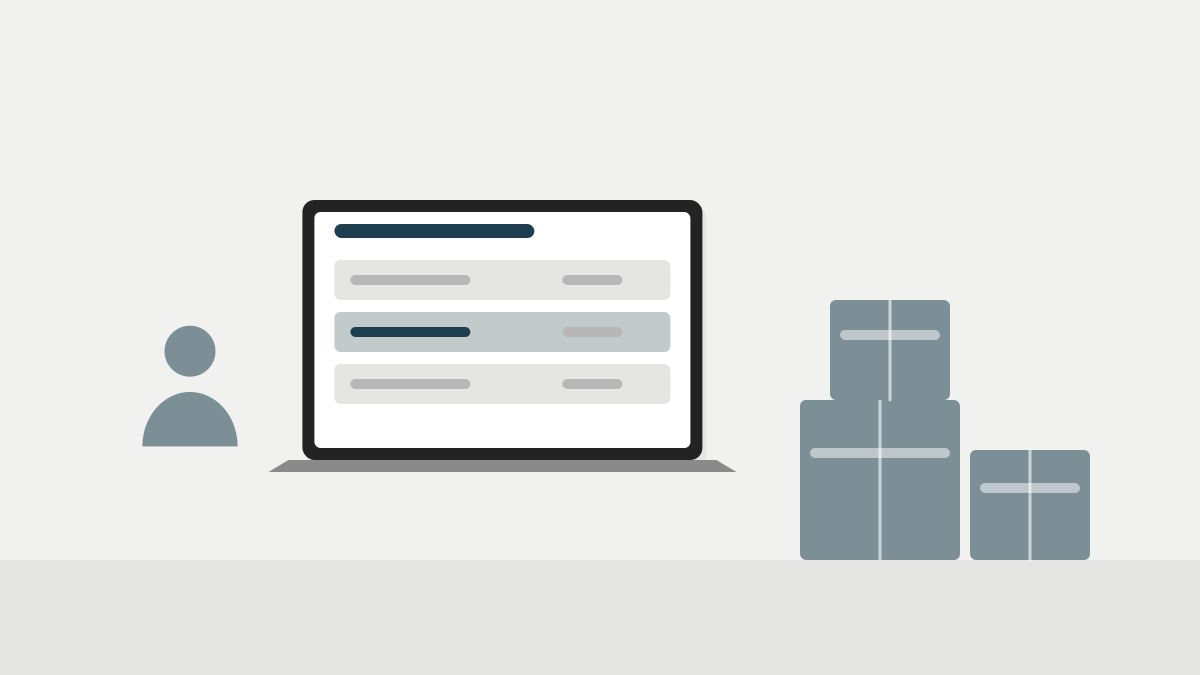
A third-party logistics provider, or 3PL, stores your stock and picks, packs and ships your orders. For a growing online business, handing that over can free up a room, a garage or a whole team. It can also replace a problem you understood with one you cannot see. The steps below are the ones we would follow again.
Step 1: Know your own order profile
Before you ask for quotes, pull three months of order data. You need the number of orders per month, the average number of items per order, the share of orders that are single items, the range of product sizes and weights, how many SKUs you hold, and your returns rate. A 3PL quotes very differently for 500 small single-item orders than for 500 bulky multi-item ones.
Step 2: Ask how every fee is triggered
3PL pricing is usually a set of separate charges rather than one rate. Ask for each of these in writing:
| Fee | Question to ask |
|---|---|
| Receiving | Is it charged per pallet, per carton or per hour? What if a delivery arrives unlabelled? |
| Storage | Per pallet, per shelf or per cubic metre? Is there a minimum monthly charge? |
| Pick and pack | Is the first item priced differently from additional items? Is packaging included? |
| Shipping | Which carriers, and are the rates their negotiated rates or a mark-up? |
| Returns | What does it cost to receive, inspect and restock a return? |
| Account fees | Setup, onboarding, software or minimum monthly fees? |
Ask about dimensional weight
Couriers often charge by size as well as weight. Ask which box sizes the warehouse uses and how they choose them, because a box that is slightly too big can raise the shipping cost of every order.
Packaging is worth a specific question for that reason. Couriers price on dimensional weight as well as actual weight, so a warehouse that defaults to one large box size can quietly add to every shipment.
Step 3: Test the integration
Your store, the 3PL's warehouse system and your accounting need to pass orders, stock levels and tracking numbers between them without manual work. Ask which platforms they connect to natively, then insist on a test: place a real order, cancel one, and check that stock levels update in both directions. Integration problems cause more day-to-day pain than any fee.
Step 4: Agree what happens when things go wrong
Stock goes missing, orders ship to the wrong address and items arrive damaged. A good contract says how stock counts are done and how often, what level of discrepancy is acceptable, and who pays for lost or damaged goods. Ask for their mis-pick rate and how they measure it.
The cheapest quote is the one built on your real orders. Everything else is a brochure.
Step 5: Visit, then start small
If you can, visit the warehouse. Tidy, well-labelled shelving and a calm packing area say a lot. Then move part of your range first, or run both your own fulfilment and the 3PL in parallel for a month. Write down the handover process as you go; our guide to writing SOPs shows how. And build the new costs into your cash flow forecast: 3PL invoices are usually monthly in arrears and vary with volume.